

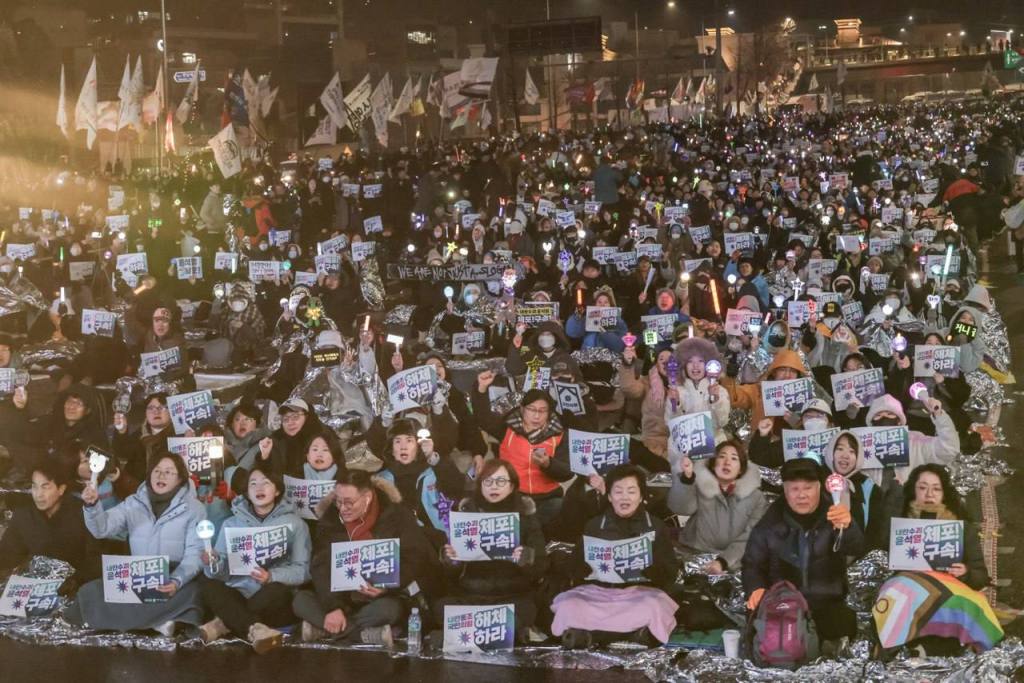
Image Credit: Emergency Coalition for Yoon Suk-yeol’s Immediate Resignation and Social Reform (윤석열즉각퇴진·사회대개혁 비상행동)
Translators’ Note: On December 31, 2024, a district court in Seoul ordered the detention of recently impeached president Yoon Suk Yeol and the investigation of his office and residence. In response, Yoon shamelessly resisted the arrest warrant issued over his shocking declaration of martial law earlier that month, which had been plunging the country into political turmoil. His presidential security service immediately barred investigators from accessing the area, with support from his lawyers’ objections.
On January 2, 2025, after a dramatic six-hour standoff with Yoon’s security forces and supporters, investigative authorities suspended their attempt to arrest him. The following day, demanding urgent action to hold Yoon and his party accountable for the insurrection, the Korean Confederation of Trade Unions announced a two-day overnight protest near the presidential residence in Hannam-dong, an affluent neighborhood of Seoul. That night, over two million protesters in Seoul braved the biting cold and filled the streets. Like the large-scale protests that had occurred almost nightly over the past month, the demonstration was peacefully and effectively organized.
Yet, this overnight protest also fostered a new political space—one grounded in a tangible sense of interconnectedness and interdependence. Throughout the night and into the next day, many young speakers helped shape this space, amplifying the voices of the underrepresented and making their stories accessible to educate allies and spark the difficult conversations necessary to expand the collective imagination of what is possible—or what else is possible. Individually and collectively, their presence embodied an act of defiance, a tenacious call for justice against impunity, and a sign of solidarity and contestation powerful enough to conjure a utopia (or a simply different world) as vitally present amid one of the most trying times in the country’s modern history.
Selected and translated below is one speech from that night (the full Korean text is shared with permission from the speaker (@BringContainer). The speaker identifies many forces responsible for dismantling democracy, including neoliberal capitalism; the privatization of public spaces; the atomization and commodification of all forms of association; the corporatization of communication alongside an overwhelming flood of information and dissemination; the systemic marginalization of the vulnerable; the pervasive anti-feminist climate; and the transformation of voting into an economic transaction. As the speaker astutely points out, these forces have aggressively fueled new forms of autocratic state formations and far-right extremism while deepening social isolation and mass resentment. This expansive critique, therefore, is more than just a denunciation of individuals in power—it is a call to action against the broader structures that are eroding democracy not merely as a political system but as a form of living-with-others.
. . .

Image Credit: Emergency Coalition for Yoon Suk-yeol’s Immediate Resignation and Social Reform (윤석열즉각퇴진·사회대개혁 비상행동)
. . .
Hello, I’m a citizen who just turned 30 this winter. This may be a difficult thing to say at the beginning: I am a survivor of domestic violence. Since graduating high school, I’ve never really been able to build a professional career. I am relatively undereducated and barely managing my life. Perhaps because of that, I’ve never felt that I had the right to stand on equal footing with others.
I’ve grown used to being beaten down. When hit, I bow down; when told to stay quiet, I stay quiet; when told to stay still, I remain still. That inertia has become my default, and now I just lie down and stay put. The reason I don’t get up is simple: there’s no one to hold my hand when I stumble. I know better than anyone that raising my voice alone won’t change society.
When I share my story, I often hear comments like: “Isn’t it because you’re lazy and dumb? Everyone puts up with that much—why can’t you? You just need to try harder. Have you ever considered that maybe you’re the wrong one?” People like me, who are seen as neither ordinary nor normal, are treated as the problem simply for existing. We are viewed as burdens to society and obstacles to progress.
Because of this stigmatization, I have never felt a sense of belonging. I don’t feel worthy of standing under any flag or cheering with a light stick for something I love. Just as the world has ignored me, I want to ignore the world. Concepts like “love” and “solidarity” feel distant, almost unreachable.
And yet, as I say goodbye to my twenties—a decade others once called “precious youth” but one I feel I’ve completely wasted—I find myself standing here. Why?
About a week ago, I stormed out of the house as my family casually insulted young people, dismissing them as lazy and accusing them of protesting just to take money from the government. I spent that night at Namtaeryeong [the site of struggle in which the Jeon Bong-jun Protest Squad of the Korean Peasants League (Jeonnong), along with citizens, confronts the police at Namtaeryeong in Seocho-gu, Seoul, on the morning of the 22nd, after driving tractors into the city]. For the first time, I learned what the Grain Management Act guarantees and the structural issues farmers face. That became my entry point. Since that night, I have stepped out of the house every day to protest.
Every morning, I join the fight alongside the Solidarity Against Disability Discrimination (SADD), stigmatized as an “illegal” protest group under the arbitrary interpretation of the Railway Safety Act by Seoul Metro. Indeed, the police and Seoul Metro suppress activists with force, dehumanizing them as if they were nuisances, claiming that “illegal” protesters are not citizens. They disregard the constitutional rights that guarantee equality, the right to move, work, and live equally. Yet, every morning, activists continue to resist the mayor of Seoul and Seoul Metro, who fail to uphold these rights.
Every Wednesday, a regular protest takes place to address the issue of the Japanese military’s sexual slavery system. The Yoon administration has avoided holding the Japanese government accountable for its war crimes, citing the 2015 Korea-Japan agreement—reached without the victims’ input—as an excuse. Moreover, through a third-party compensation plan, where the Korean government compensates victims on behalf of Japanese corporations, they have completely failed to hold war criminals accountable.
Every Thursday, workers who were unjustly dismissed protest in front of the Sejong Hotel near Exit 10 of Myeongdong Station. Sejong Hotel selectively targeted and dismissed union members who had devoted more than a decade to the hotel. Despite the Supreme Court ruling last month that these dismissals were legitimate, they continue to fight for reinstatement.
Just four days before the Jeju Air 2216 crash, Park Seung-ryul, co-representative of the 4.16 Foundation, spoke at a remembrance vigil for the Sewol Ferry disaster, calling for the enactment of the Basic Life and Safety Act to create a world where disaster victims can console and support one another without tears.
Even now, Dongduk Women’s University continues to unjustly oppress its students. The university administration has unilaterally and coercively proceeded with major changes, such as department mergers and a transition to an engineering focus, without consulting students. They also failed to implement the safety measures until a fatal accident occurred, the measures that students had long demanded. Worse yet, they are now suing students for an exorbitant amount in damages to silence them.
In the meantime, the Shipbuilding Subcontractors Division of Geoje, Tongyeong, and Goseong [of the Korean Metal Workers’ Union] continues its fight for the right to unionize. In a country where the government no longer serves its citizens, our Metal Workers’ Union stands stronger than ever: one union member has been on hunger strike for over 40 days. This strike aims to protect and promote worker safety and health in the face of Hanwha Ocean’s aggressive union suppression through unreasonable damage claims.
It is such a shame that I have only just learned of their stories and realized how interconnected they are. The Solidarity Against Disability Discrimination (SADD) supports the Dongduk Women’s University students in rallies. The Korean Confederation of Trade Unions joins the Palestinian solidarity march, chanting “Free, Free Palestine.” At the cultural protest of the Geoje Tongyeong Goseong Shipbuilding Subcontractor Union, disabled activists stand in solidarity with workers. Ji Hye-bok, a school teacher who was unfairly transferred after whistleblowing on a sexual assault case, continues to stand in solidarity with those people with disabilities wanting to move freely, those workers staging high-altitude protests, and those in Gaza.
I am confident. If you have ever witnessed these fellow citizens speaking at these rallies, you would find it difficult to dismiss their demands as unfair or selfish. We have merely not met each other until now. Here we finally come to understand that what we truly desire, at its core, is to share our experiences. We fight because we refuse to be subdued by power. In this fight, we stand against leaders who recklessly promote fascism.
We, the people who gather here, are constantly calling out for those who have been ignored. These include female students at women’s universities who are facing threats to their education under undemocratic decisions, victims of gender-based violence who cannot prove their suffering according to rules created by others and thus cannot hold perpetrators accountable, residents of Yongjugol whose homes were demolished with only minimal compensation, people with disabilities confined to rehabilitation centers or their homes with nowhere else to go, immigrants ostracized as outsiders, victims of irrational governmental policies who are tortured and oppressed in the military, workers stripped of their jobs, those denied fair wages and reasonable accommodations, laborers forced to work in dangerous conditions where their lives are treated like disposable tools, farmers who, despite being the backbone of the nation’s food self-sufficiency, lack protection, people who lost loved ones due to irresponsible government responses to disasters, youth whose political rights are not respected, transgender individuals who reject their assigned genders, nonbinary individuals unacknowledged or unclassified, those who love people outside traditional marriage structures or choose not to love at all, individuals of diverse sexual orientations, Palestinians being massacred under international neglect, and all non-human entities and ecosystems dying without even the ability to protest.
All these individuals, relentlessly forced to prove their existence, are here—those who are dehumanized, objectified, and exploited. They are all part of this shared struggle.
Under the oppressive political actions of the People Power Party and Yoon Suk Yeol, most of us have been reduced to mere scapegoats. Those with nothing lose even more and are left resenting each other, clawing at scraps to claim what little remains. This is a miserable world to endure.
The question, “Can the dead save the living?” confronts us. If the answer is yes, then I believe it must also be possible for the living to save those who will continue to live. I do not want to pass on a life where one must endure until death, hide one’s flaws, conform to violence, and deny oneself. I want to break free from a life where every moment is a battle for survival and existence. We are all fighting so that one day, we no longer have to fight. We want to live lives worth living.
The people who first came to occupy the streets are the ones most like me. Now it’s time for all of us—those who could never truly be sovereign citizens in a democratic system—to pay attention to everyone’s stories. We, who once believed we were atomized and could never come together, have met either in the overlaps or the exclusions of our lives. No longer isolated in our struggles to protect our domains, we meet on intersecting paths and walk together. As Jeon Tae-il’s words, referenced by a previous speaker, remind us: We are all interconnected.
I am one of the multitudes. I am a woman who was sexually harassed by a man old enough to be my father while looking for a part-time job. I am a disabled person mocked as a “perfectly healthy invalid” while staying at home. I am a migrant worker who almost took a job abroad where rest breaks and minimum wages were not guaranteed. I am a sexual minority who wants to exist outside the binary spectrum of men and women in their 20s and 30s. I am a logistics worker who fractured my spine and shudders and was told to “just go to Coupang [the country’s e-commerce giant that has notoriously exploited workers]” for another job. I am a dispatched worker who was forced to do tasks outside my role because a hospital rejected my experience as a temporary worker. I am a college dropout who fled spaces that forced normalcy upon me. I am a child who survived domestic violence and yet was too helpless to claim my own rights. I am an environmentally conscious vegetarian, forced to eat meat at home despite resisting an anti-climate world. I am, in other words, a sum of the parts of you all.
Things I never wanted have been violently imposed on me. These things have, at times, defined me. There are even aspects of myself that I wouldn’t choose to claim as mine but have somehow become a part of me. And yet, I refuse to condemn the pieces that make me who I am.
What I wish to share isn’t simply about my personal experience. Once again, the world is intricately connected. Violence inflicted on one individual is never confined to just that person. Hatred spreads like wildfire. The safety guaranteed to the most vulnerable among us becomes the safety net that can catch anyone when pushed to the edge. This is what I want to emphasize.
I am a part of you, and you are a part of me. Here, I’ve met people like me—people who wouldn’t hate me—and through all of you, I’ve finally found the courage to love this cruel world. In the past, even when standing under a flag that represented a part of who I am, I couldn’t fully feel at ease. But now, as someone who is part of a movement that embraces all forms of vulnerability, minority identities, and diversity, I finally feel a sense of peace under every flag here.
The state may be lagging behind, but we have already surpassed its legislative, judicial, and executive branches to build a democratic society—one where we understand each other’s pain and share a vision for the future. I see a connection between survivors of domestic violence and survivors of state violence. I recall a time when resistance, hope, and love felt futile in this world. But now, I know they are anything but futile.
To everyone here, I want to express my gratitude. And I have one request: that you will continue to stand by those who feel alone, ensuring no one has to face loneliness by themselves. Until the day a truly democratic state becomes our home, let us remain resilient and move forward together. To conclude, instead of ending with “tujaeng [meaning “a call to fight,” a closing word that has been used by many protesters],” let us take a moment of silence. Thank you.

 DKS Collective
Leave a comment